How Many Bags of Salt Do You Need for a Pool Start-Up?
For pool owners who’ve just installed a new saltwater pool or converted their chlorine pool to saltwater, correcting the salt content when adding salt to a pool for the first time is essential. You may wonder: how many bags of salt for pool startup? After calculating the volume of the pool, it’s a relatively simple process to determine exactly how many bags of salt are. For pool start-ups, the circulation system, which will ultimately dissolve and distribute the salt throughout the water, will also help keep the water balanced.
Why You Need Salt for Starting Up a Pool
Adding salt to a pool for the first time is essential to chlorinating the water. Still, it’s not just about determining how many bags of salt to add —you must establish the right balance to ensure that the salt level never falls too low. If it does, the chlorine generator won’t be able to keep the water sanitary and may even stop functioning. Conversely, corrosion can damage surfaces and pool equipment if salinity becomes too high.
For this reason, it’s important to consider more than just the number of bags when adding salt to a pool. For first-time owners of saltwater pools, it’s vital to know the level of salinity at which the water should ideally be. Preferably, salt levels should be between about 2700 to 3400 ppm (parts per million). This means that for a 10-thousand-gallon (37,854.12 liter) pool containing no salt, just over 225 to just under 284 pounds of salt (about 102 to 129 kg) will need to be added. That’s about five and a half to just over seven 40-pound (18.1 kg) bags of salt.
The same idea applies when re-adding salt to a pool at the start of the swimming season. For first-timers adding salt, it’s unlikely that more salt will be needed later in the season as the chlorine generator will continue to produce chlorine from the salt through a process known as electrolysis. The chlorine produced will then sanitize the pool. While this salt will remain in the pool, should it rain or if fresh water is added, it becomes diluted. If salt levels are low, the salt chlorinator’s effectiveness is reduced, resulting in lower chlorine production.
Calculating How Many Bags of Salt for Pool Startups
The ideal level of salt in a pool is 3200 ppm. Luckily, there’s a relatively simple formula for determining how many bags of salt pool startups need to add.
This formula helps determine this level:
- Gallons of water a pool holds x 8.35 x (0.0032 – current salt levels in ppm) = amount of salt to add
Pool-grade salt is generally 99.8 percent pure sodium chloride produced via evaporation while having no iodine and coming in granulated form. This type of salt is also considered food-grade and should be used whether initially adding or re-adding salt to a pool. For first-time dissolution into the pool’s water, alkalinity and pH must be balanced correctly before salt is added.
Testing Salt Levels
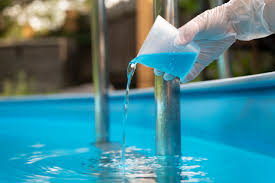
It’s also essential to keep from misadding salt to a pool. For first-time or mid-season salt additions, testing of salinity levels should always be done to ensure chlorine levels remain stable. The saltwater pool’s chlorine generator should be checked first, with a digital display that indicates the salinity reading. However, these chlorine generators can also give inaccurate salinity readings, so other tests should also be applied.
Either or both of the following two methods will help verify the chlorinator’s display:
- Salt test strips: These strips are dipped into a sample of pool water and, depending on the type, will take from under half a minute to several minutes; though less accurate than a digital tester, it provides an estimated reading and can determine whether digital readings from the chlorine generator are accurate.
- Liquid saltwater reagent test kit: Liquid test kits also require a sample of pool water, which will change color when the reagent is added; this should be done in strict accordance with the instructions that come with the kit to ensure an accurate reading.
- Digital salinity tester: Though these are often included in saltwater chlorine generators, handheld models that look like digital thermometers are more accurate for measuring salt content; manual methods like test strips or test kits should be used to corroborate the accuracy of a digital tester at least occasionally to ensure continued accuracy.
If a digital reading significantly differs from the test strip or kit, the digital reader may require recalibration, or the salt sensor may need cleaning. However, it could instead result from low water temperatures, as these can result in lower salinity readings. Inaccurate readings can also result from high TDS (total dissolved solids) counts or other minerals within the water.
How to Add Salt to Your Pool for the First Time
When adding salt to the pool for the first time:
- Calculate the amount of salt that needs to be added to the pool to bring it up to at least 2700 ppm, though 3200 ppm is best.
- Based on this calculation, estimate how many bags of salt are required for pool startup.
- As it’s easier to add salt than remove it from a pool’s water, it’s usually best to aim for a lower salt content.
- Turn off the saltwater chlorinator; some chlorine generators won’t need to be turned off when adding salt.
- Leave the filter and pump running to dissolve the salt and help circulate it through the water.
- Salt can be added around the perimeter, in the shallow end, or in the deep end, though it should be avoided directly entering the skimmer.
- However the salt is added, it’s best to do so uniformly as this will cause it to dissolve more quickly.
- Push the salt along the bottom with a pool brush to encourage dissolution.
- Allow the salt to completely dissolve in the water and circulate, which can take up to 24 hours.
- Once dissolved, turn the saltwater chlorinator back on.
- Test salt levels to ensure they are at least 2700 ppm, as lower levels make the saltwater chlorinator less effective.
- If salt levels are still too low, repeat the process until they’re acceptable.
Usually, salt is only needed at the beginning of the season, though backwashing, rain, or splashing out can lower the salt content to below-ideal levels. If the salt levels reach 5000 ppm or higher, diluting the pool with fresh water will become necessary.
Contact the Pool Experts at Halogen Supply
If you’ve recently converted a chlorine pool into a saltwater pool or built a brand new one, Halogen Supply can help you determine how many bags of salt are needed for a pool startup. So, if you’re adding salt to a pool for the first time or simply need guidance with next steps on your pool project, contact the pool experts at Halogen Supply today.